


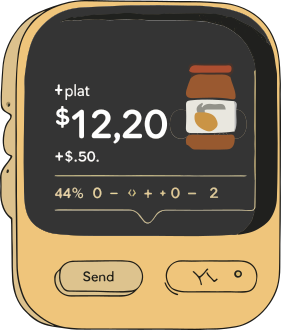
Dynamic Pricing
automatic price adjustment based on demand, expiration dates, competitors, and time of day.
At HIVELAB, we are building a comprehensive intelligent model of food supply—a system that integrates every stage of the value chain, from large-scale distribution to the consumer's refrigerator. Each component of this system is developed and tested in our field laboratory—the MinaMart supermarket.
To restructure the process of society's food supply by creating a holistic, data-driven, and self-optimizing ecosystem.
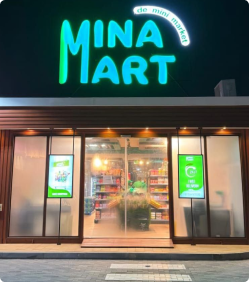
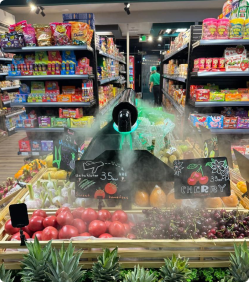
MinaMart supermarket
We help people get quality products on time and at fair prices. Our technologies make shopping more convenient and choices more conscious.
We create tools for accurate demand analysis, assortment optimization, and cost reduction. This helps businesses grow and offer customers better service.
Our research and solutions simplify the mechanism of food supply to store shelves and customer refrigerators.
Our solutions support the development of a sustainable food system. We help forecast market needs, ensure food security, and increase industry efficiency.
We start by creating a high-resolution retail trade map that is continuously updated by autonomous AI agents working with supplier databases, e-commerce APIs, and open market data.
01
We collect, normalize, and match information about products, suppliers, assortment, prices, and availability, identifying gaps, redundancies, and anomalies in demand and distribution.
02
We perform market clustering: analyzing consumer behavior and market trends to forecast demand and optimize assortment.
03
We obtain a set of derived market characteristics and create intelligent recommendations to improve supply chain efficiency and reduce waste.
Electronic statistics and analytics system for food products and catering.
We use both open-source data and business-derived data—supply and demand, consumer preferences, etc.
automatic price adjustment based on demand, expiration dates, competitors, and time of day.

AI predicts sales volumes for each SKU considering seasonality, holidays, weather, and local events.

recommendations on which products to remove or add based on sales data and shopping habits.
The Golden Catalog is the central semantic core of the retail ecosystem—a unified and continuously evolving representation of all food products and consumer goods, their attributes, relationships, and market behavior. It simultaneously serves as a knowledge base, computational model, and semantic interface between suppliers, stores, and consumers.



In Hive Lab's architecture, the Golden Catalog functions as both a formal theory and a working foundation upon which intelligent retail systems are built.
This representation transforms the catalog from a static database into a living semantic model—extensible, self-consistent, and compatible with other retail systems.

E - product entities (items, attributes, brands, units of measurement);
F - operations (aggregation, synonym matching, category inheritance, temporal price functions);
R - relationships (equivalence, substitution, time-dependent pricing)

product movement analysis and alerts about approaching expiration dates to mark down or relocate in time.
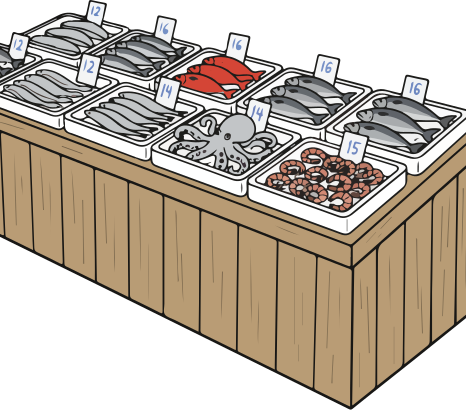
cameras and sensors analyze color, shape, and moisture of produce, meat, or fish, determining when they need replacement.
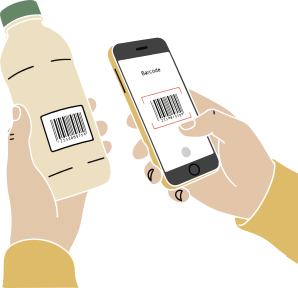
Learn product composition, whether it's suitable for children, your dietary approach, and discover the country's average price for the item
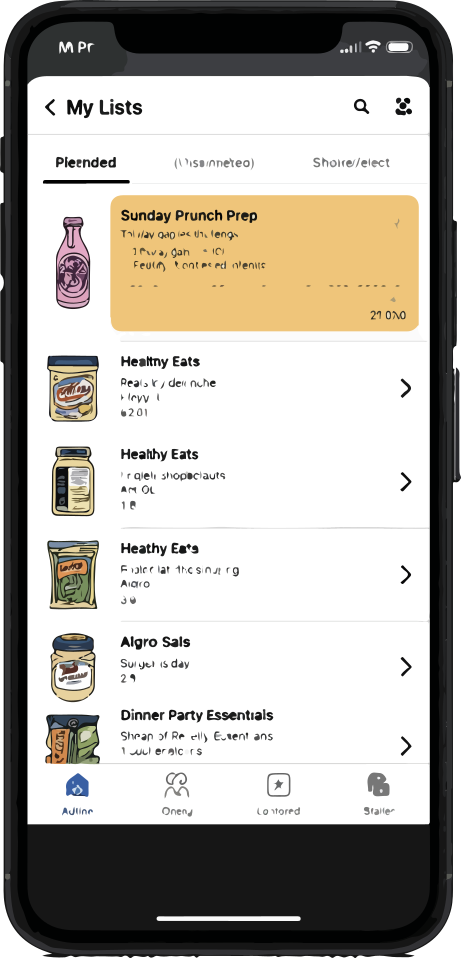
The store-level catalog is a projection of the Golden Catalog onto a specific operational and geographical context. It maintains the theoretical integrity of the parent ontology while adapting to practical constraints:
The Golden Catalog defines both assortment logic and pricing policy, forming the structural foundation for every commercial decision.

Thus, each store becomes a localized instance of a global information system, semantically synchronized with the universal model and adapted to its own market conditions.
We automate the receipt of goods and invoices from suppliers, instantly aligning each incoming document with our Golden Catalog to maintain semantic consistency and track prices throughout the chain. This process receives special attention as it represents a critical node in the upcoming transformation of distribution networks.
By synchronizing supplier data within a unified ontology, we lay the foundation for intelligent distribution systems capable of autonomous coordination, adaptive supplier selection, and real-time procurement decisions.

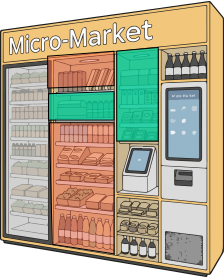
predicting when and how much product to order to minimize surplus and shortage.
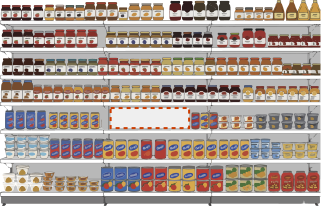
the system recognizes empty shelf spaces through cameras and sends a signal to staff/robot.

The system analyzes traffic, weather, and courier workload → builds optimal routes, and the buyer receives an accurate arrival time
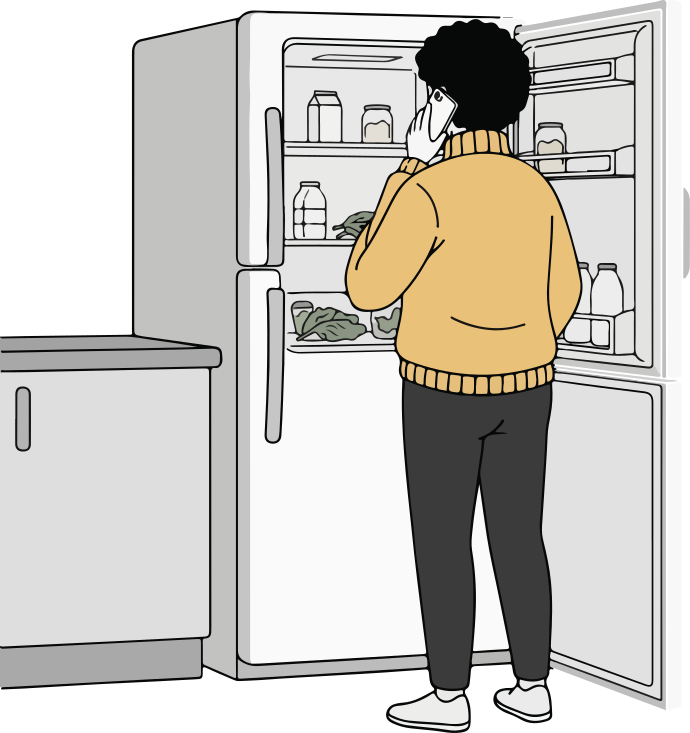
When the infrastructure is ready, we will integrate an AI voice assistant—a natural language interface between human life and the intelligent retail network. It extracts information from order history, context, and preferences, creating personalized voice-driven shopping scenarios.

The assistant helps shoppers intuitively and efficiently restock, connecting the consumer's refrigerator directly to the living supply logic.
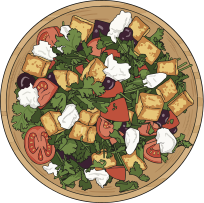
forms a list by dishes and shows where they are located in the store.

You get exactly what you need—products, promotions

The Food Retail Program represents a complete cycle of food supply chain reorganization—a continuous adaptive pipeline where theory, data, and human behavior merge into a unified intelligent process.
Through MinaMart we test and refine this model in real conditions, shaping not disruption but ecological evolution of existing systems toward transparency, efficiency, and balance. HiveLab—developing the algebra of everyday commerce.



The Golden Catalog also serves as the semantic core for continuous expansion of the food product analysis system. Its structure provides a natural foundation for knowledge expansion and interaction throughout the entire product lifecycle: from production and ingredient sourcing to ensuring complete traceability from origin to expiration date; and from consumption to experience, integrating recipes, nutritional information, and behavior in a single conceptual space.
Through this semantic expansion, the Golden Catalog becomes not just a data model, but a generative intelligence layer: a unified algebraic continuum connecting food preparation, distribution, and perception processes.